

A Duty Officer’s Diary at the Safe Line for Journalists’ Safety
By Veran Matić
Many would say that all of this is excessive, but the figures on attacks and threats against journalists show a steady increase, while the number of resolved cases is declining. The prosecution generally turns a blind eye, while the police no longer protect journalists and even attack them. We are left to rely on mutual solidarity.
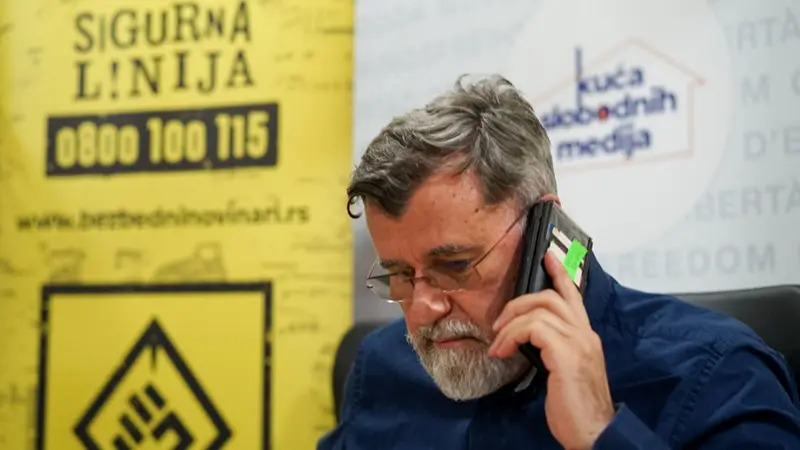
I frequently serve as a duty officer on the Safe Line, ANEM’s SOS hotline for reporting threats and attacks against journalists. During the final week before the elections, one thing has become crystal clear: what international journalism organizations have been saying for a year now is true—in all of Europe, Serbia is currently the most difficult country in which to be a journalist.
Saturday, October 17
I don’t like weekends. That is when most attacks against journalists take place and most threats are made against them. Weekends are also an especially dangerous time for women experiencing domestic violence. I don’t want to construct a theory around this, but I know that women journalists in our profession are more exposed to aggression and face extraordinary levels of threats. Even when you analyze the content of threats directed at journalists, you notice that they are full of threats of sexual violence.
In the afternoon, lawyer Ninić informs us that Ljubomir Stefanović, the owner of the Slavija-info website and its very popular YouTube channel, has gone missing. Two years earlier, he had already been kidnapped by representatives of the Security Intelligence Agency (BIA). His mobile phone had been examined using data-extraction devices, and spyware had been installed on it. He had been detained, his apartment and premises searched, and electronic devices confiscated. That is why we are worried now, too. He disappeared after police broke into his home while he was away, conducted a search, and took away some evidence. He could not determine what had been taken because he had not been there, and the house was subsequently sealed. Lawyers are trying to find out where he is. We are waiting until morning to continue our efforts.
In the evening, a colleague—the most ethical among us, whom every government has demonized and whose health has been destroyed—tells me that she will once again have to leave the country because she cannot obtain the medical support she needs here. We embrace each other from a distance. I know that, however difficult things may become for her, she will stand alongside all of us here. Simply because she can, as young people would say.
That is how several generations of journalists have been taught: the public interest comes above everything else.
Sunday, October 18
Journalist Ljubomir Stefanović has been unreachable for 24 hours. He is not responding to his family, his newsroom, or his lawyers. Naturally, our minds turn to the kidnapping and murder of Ivan Stambolić and the execution of Slavko Ćuruvija. (I have witnessed more than 40 years of the evil inflicted on journalists and the media).
On behalf of ANEM, I issue a public demand for the police and prosecution to answer one question: Where is the journalist against whom they have apparently initiated some kind of proceeding?
An answer soon arrives, not in the form of an official statement from the institutions, but through Aleksandar Vučić’s mouthpiece, the television channel Informer. From this, we conclude that Stefanović is not in their hands—that is, he is not in prison. We continue searching because, beyond the police and prosecution, we have far more powerful para-police forces loyal to the former president, comprising violent individuals, criminals, and murderers.
We hear from our colleagues at Bečejski mozaik and Webinfo in Novi Bečej. They were prevented from covering an SNS promotional event that was apparently organized by the Pension and Disability Insurance Fund (PIO Fund). Our colleagues had many questions they wanted to ask, but they were physically prevented from attending a meeting between SNS officials and a selected group of 150 pensioners, both women and men. We write formal protests to the institutions and alert the public. We document discrimination against journalists, obstruction of their work, and interference with their coverage of pre-election activities.
Monday, October 19
Željko Matorčević, from the Žig info news portal in Grocka, who was brutally beaten in 2018 shortly before his colleague Milan Jovanović’s house was set on fire—a blaze from which Jovanović barely escaped alive—publishes an article about 47 registered voters at the address of a local funeral services company. You might say there is nothing new about that. But a few hours later, Željko sends us a recording of a telephone conversation. A woman who lives at that address called him and explicitly threatened to beat him, without explaining anything about the 47 voters registered at the funeral home. Together, we report the case to the prosecution and the police.
…
We receive information that Ljubomir Stefanović has left the country. He soon issues a video statement explaining that he has gone into hiding to avoid being detained, held in custody, placed under house arrest, or prohibited from using the internet—all measures that would prevent him from carrying out his work as a journalist and editor. We later learn that he is in Montenegro.
It bothers me that he uses the term “escape,” because I believe that the authorities in Serbia forced him to leave the country, expecting that this would put an end to his activities.
Following Aleksandar Radić, Stefanović is the seventh journalist from Serbia to go into exile, in addition to five others who had previously been relocated or had left the country on their own because their safety was at risk. Both Radić and Stefanović faced the direct threat of imprisonment and legal proceedings.
Journalists in exile are particularly vulnerable during their first days away, and I try to help them precisely at that time. We are gathering support not only to cover their living expenses but also to provide the equipment they need to continue working from their new locations.
It is extremely important to thwart the repressive apparatus’s attempt to silence free speech and objective reporting by persecuting journalists.
Tuesday, October 20
A day to be proud of for the journalists at the Mašina newsroom and Mladen Savatović, recipients of the Dušan Bogavac Award for Ethics and Courage. I have always regarded this award as a kind of preliminary qualification for everything else in a journalistic career: ethics—respecting the journalistic code—and the courage not to buckle under various pressures, but instead to dedicate your life to protecting the public interest. Mašina and Mladen have demonstrated both qualities to an extraordinary degree. They thoroughly deserve the award!
But then shocking news arrives from Prijepolje. TV Forum, the first civil-society media outlet in the country, founded by women and operating with all the necessary permits, has been brutally overridden without any warning by the signal of Informer TV on Telekom’s cable network. At that very moment, a promotional event for the Student List is taking place in Prijepolje. Yet on TV Forum’s channel, displaying the TV Forum logo, viewers are watching Informer TV programming—in other words, a broadcast of the presentation of the Aleksandar Vučić – United Serbia list in Čačak.This act of violence and takeover of the channel continues for almost 24 hours.
We send formal protests to institutions that have been captured or rendered dysfunctional. All we can do is raise our voices. After reading our statement, a representative of an embassy calls me to ask whether he has understood it correctly and whether such a thing is possible. I tell him that this is yet another method of destroying independent media.
For a year now, I have repeatedly encountered the same reality: representatives of the international community, from Brussels to national administrations and diplomatic missions, regularly record the alarming number of attacks and threats, SLAPP lawsuits, discrimination against media outlets, and the targeting of journalists by the until-recently president and other government officials. And yet, they still struggle to grasp and address all these developments as a whole, because doing so would mean acknowledging that they, too, are complicit when they cooperate with and frequently support such a government. I believe one of the biggest problems is the absence of serious institutional support for professional journalists and media outlets in Serbia.
Instead of acknowledging the reality and taking concrete measures—for example, as the Swedish government did by halting financial assistance to the Serbian government that had already been agreed upon, redirecting some of that support to civil society, and deciding not to participate in EXPO 2027, probably one of Europe’s largest corruption-driven projects—international partners settle for lukewarm warnings while maintaining their relationships with Serbia’s authorities.
When I was little and experienced some injustice, I would imagine and wish that something would happen to me, that I would die, so I could watch whether the people I was angry with would feel sorry and who would cry. I have the impression that, when we speak with representatives of the international community—especially those who have the power to influence the behavior of a repressive government more effectively—they are waiting for precisely that moment: for us to be gone, so that they can finally say and do something that the authorities will remember.
…
I attend a solidarity protest in support of the Nova.rs newsroom, as well as N1, Nova S TV, Danas, Radar, and others. At the same time, we see protests being organized in Ljubljana, Zagreb, Sarajevo, and Podgorica. It is never enough. There are never enough people, never enough solidarity. Vuk Cvijić shows me the front page of Radar, which is due to be published on Thursday. He tells me about the article. I am already bracing myself for the threats he will inevitably receive. His wife, Bojana, is the executive editor at Nova.rs.
I am particularly concerned because I know how steadfast both Vuk and Bojana are. I try not to react only after a threat or an attack has already occurred, but also to take at least some preventive measures. Yet I am no longer sure that we have any room left for effective prevention.
When you are a professional journalist and feel a strong need to protect the public interest, there is little room for maneuvering. You publish everything you discover and can substantiate, because the public has the right to know—and must know.
Wednesday, October 21
Nenad Kulačin, one half of the Dobar, loš, zao (Good, Bad, Evil) podcast duo, sends me a message saying that he has received a threat of sexual violence directed at him, his wife, and Marko Vidojković. The threat also says that the perpetrators will “come for them on October 26.”
Nenad and Marko are certainly among those who receive the greatest number of threats and disturbing messages, as do their families. Nevertheless, the content of these threats and the accumulation of attacks that the institutions fail to investigate always disturb me. We report the threat to the Special Prosecutor’s Office for High-Tech Crime, but we do not expect any progress because this prosecution service, too, has long been captured.
I am worried about Nenad and his family. Marko has been relocated and, after three years, has obtained residency in a foreign country. For family reasons, Nenad has been unable to move out of the reach of those threatening him. We are trying to help with preventive measures, but our options are limited. When we arrange video surveillance, we cannot be sure whether it will help prevent an attack or merely allow us to see who committed a violent act after the fact. Still, we do everything we can.
Thursday, October 22
Radar has been published. I read the article by Vuk Cvijić and Milan Radonjić about newly uncovered Sky ECC messages revealing how people from the upper echelons of organized crime in the region view the former president, his brother, his son, and other people close to them, as well as what they say about their communications with these individuals and their influence over their decisions. It is a continuation of the article published in the previous issue. Courageous journalism—but there was no other way it could have been, knowing Vuk and Milan.
I am preparing myself for the new threats that will follow, because I do not expect the people named in these messages to be arrested, even though we know that the former president has, during this period, lost his immunity. And sure enough, the threats follow: attacks against family members and the murder of children. Once again, I report them to the prosecution. Since the attack on Vuk by Ladjević, the director of Srpski telegraf, in the city center—an incident that has gone unpunished to this day—I have increasingly felt like a chronicler of attacks against Vuk rather than someone who has managed to change anything through reports to the prosecution. But both he and I know that it is our responsibility to do everything we can to expose the true nature of the repressive regime. And not only that, but also to help everyone else whose safety is at risk. We must make visible all the information that reveals the immense scale of corruption and the connections between those in power and organized crime. We must protect Vuk, Milan, and the many other journalists—women and men—using every means at our disposal. And more than that.
…
Two days ago, a KTV television crew and Nemanja Šarović were attacked while filming a report about SNS call centers in New Belgrade. They had followed buses from Novi Banovci transporting people who work in these call centers. As expected, one of the SNS activists attacked Šarović, snatched the phone he was using to record, and fled. Šarović chased after him to recover his phone, and the entire incident was captured on video. Meanwhile, tabloid media reported that Šarović had attacked a citizen.
I experienced exactly the same thing outside the Serbian Parliament, when my mobile phone—which I was using to record an incident—was snatched from me. Instead of handing the footage over to the investigative authorities, the Serbian Parliament sent it to tabloid outlets, which then published the lie that I had attacked the assailant!
The prosecutor serving as the contact point for the Permanent Working Group for the Safety of Journalists informs me that a case has been opened and that she is working to gather information. We rarely receive feedback from prosecutors, so for once it feels as though someone is actually doing their job. The harder part comes next: for a year and a half, the Ministry of Internal Affairs (MUP) has been obstructing investigations into attacks against journalists. According to the records of the Supreme Public Prosecutor’s Office, of the 99 reported cases of threats and attacks recorded by the end of August this year, the MUP failed to respond to requests to gather information in as many as 58 cases.
Friday, October 23
Throughout the week, we have been experiencing a wave of bot attacks targeting the websites of numerous media outlets and civil-society organizations. These are preparations for what we have been warning about since January: the authorities’ intention, once they believe they are losing the elections and decide not to recognize the results, to block media accounts on social networks as well, plunging Serbia into darkness by depriving it of free and professional information. The SHARE Foundation, together with journalists’ and media associations, has been working to inform service providers about the attacks. We expect them to help prevent restrictions on internet-related freedoms.
Thanks to the internet, we overcame a broadcasting ban at Radio B92 as early as 1996. Then, in 2000, when SPS storm troopers occupied our newsroom, we used the internet to broadcast authentic Radio B92 programming and its television productions.
I believe in journalists and media outlets in this year, 2026, too. I hope they will prove more effective and innovative on the internet than the regime, because our motives and goals are diametrically opposed: prosperity, democracy, and freedom versus a media desert, media darkness, and threats to journalists’ lives and the survival of professional media.
…
Whatever happens on Sunday and in the period that follows, the situation facing journalists and media outlets will be extremely difficult. Even today, the media community is already at the limits of its strength and capacity.
There is no response to even the most obvious physical and other attacks, or to the economic collapse. Professional journalists and media outlets survive solely because of their fanatical commitment to the fundamental principles of their profession, the solidarity of a small number of people in similar circumstances, and the support of part of the wider community.
We have reached a point where any further deterioration in the conditions facing journalists and the media could be irreversible. That is why it is extremely important for everyone to do everything they can to establish at least the most basic conditions in which the outstanding professionals in this field of journalism can continue to work.
 Djordje Jokic
