

Veran Matić appeals to European institutions over Minister Boris Bratina’s statement
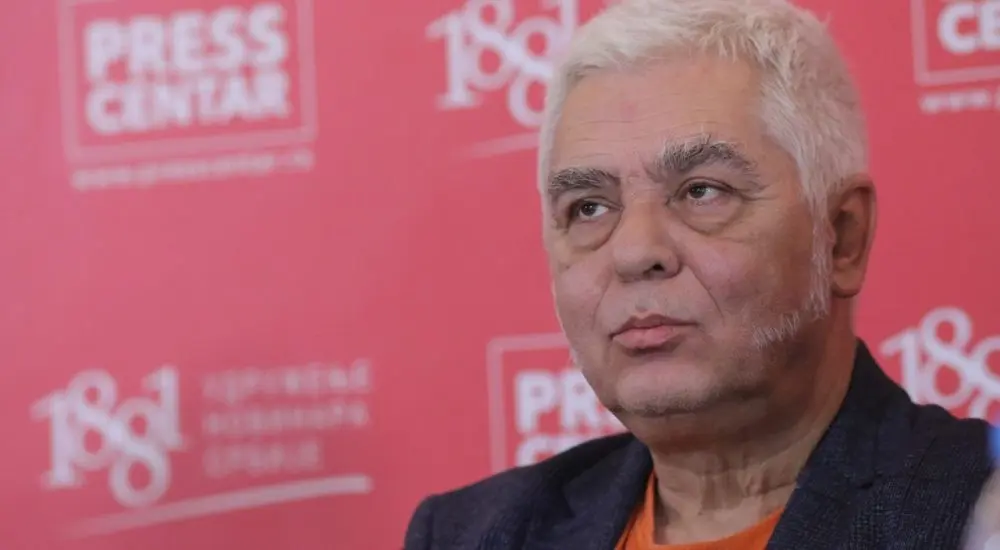
The letter is published in full below:
Dear Sir/Madam,
You are likely unaware of the fact that the Minister of Information and Telecommunications of the Government of the Republic of Serbia, stated on April 4, 2026, in an interview with Tanjug Television: “They (the students) are not aware that the police there have the right to beat them and kill them.”
I am addressing you as a representative of the Association of Independent Electronic Media, which is often subjected to international pressure to participate in working groups for drafting new laws, amending existing ones, or selecting members of regulatory bodies. At the same time, we are criticized for pointing out that neither the existing laws—adopted with our participation—nor media strategies have been respected, either during the mandate of the previous minister or his predecessors.
Freedom of journalists and the media in Serbia has never been at a lower level.
Under such circumstances, the duty of the Minister of Information and Telecommunications in a government that declaratively supports pro-European policies is performed by a former member of a pro-fascist movement who gained media visibility by publicly and proudly burning the European Union flag.
Given the importance of the portfolio he leads, this minister represents a symbol of the current Government of Serbia. The President of the Republic, the Speaker of the National Assembly, and numerous other politicians from the ruling coalition compete to match his rhetoric. This is not merely rhetoric—it is a policy of violence that has taken hold in Serbia, especially over the past year and a half.
By stating that “the police have the right to beat them and kill them,” this minister has effectively legitimized violence against students who were peacefully protesting and who were subjected to brutal treatment by paramilitary, pro-government groups and members of special police units, including torture and unlawful detentions.
Of course, this does not concern only students, but also citizens, journalists, and media workers who recognize themselves in the threats issued by the minister.
At the same time, the minister justifies smear campaigns and the targeting of journalists through propaganda content that directly endangers their safety, labeling it “investigative journalism.”
He frequently links his hostility toward independent and professional media with chauvinistic attitudes toward Croats, while arbitrarily labeling certain media outlets as “anti-Serbian,” thereby deliberately targeting them and indirectly calling for their banning or removal from the public sphere.
According to assessments by domestic media and journalistic associations, as well as leading international organizations for the protection of media and freedom of expression, Serbia is currently witnessing the systematic destruction of professional media, accompanied by intensified repression of journalists that could escalate into physical attacks with severe consequences. Journalists have for years been exposed to threats, attacks, and public campaigns of discreditation.
All of the above has been documented in reports by the European Commission, the Council of Europe, and the OSCE, as well as in increasingly frequent—though so far largely verbal— reactions by international institutions.
Unfortunately, these reactions have not produced results. On the contrary, they appear to encourage further escalation, as violence is increasing day by day and rhetoric is becoming ever more explicit—not only in justifying violence (“beat and kill”), but also in directly calling for it.
It is additionally alarming that certain members of the Government irresponsibly call on parents not to enroll their children in public universities (“because their children will end up in coffins”), spreading disinformation and panic while targeting most universities in Serbia.
The fact that we still live in a country that is becoming increasingly unbearable for normal life may be our problem, but it is incomprehensible that representatives of the European Union and other multilateral organizations continue to cooperate with a regime whose officials implement and publicly justify violence, while constantly intimidating citizens. Such conduct could be interpreted by some as a form of tacit complicity in violence against the citizens of Serbia.
We urge you, in your communication with the authorities in Serbia, to remain consistent with universal principles rather than guided by current interests and one-sided information provided by representatives of the ruling government.
In Serbia, there are no longer institutions we can turn to with the expectation that they will act in accordance with the law, European standards, and universal values.
Through their daily behavior, gestures, statements, and inaction, the authorities in Serbia have effectively deviated from their own strategic commitments, including the European path and the implementation of obligations undertaken through international agreements.
When we see representatives of the international community expressing support for authorities whose officials justify violence against students and journalists, while the legal system is being undermined and perpetrators of violence are being effectively amnestied, we must ask whether an adequate response will follow to prevent the spread of extremism toward media, students, activists, and citizens in Serbia.
We believe that most of you share the values we advocate. Therefore, we call on you to do everything within your power to preserve at least the minimum conditions for professional journalism in Serbia. Professional media are essential not only for the security of Serbia, but also for the region and Europe.
Unfortunately, the Serbian state financially and systematically supports media outlets that daily spread disinformation and hate speech, thereby destabilizing not only its own society but also the region and the broader European area.
It is important for you to understand: your actions will define what Europe is today and what the plans of its institutions are.
Given that there are grounds for suspicion that certain ministers are committing criminal offenses, and that the judicial system in Serbia is not responding adequately, we inform you in advance that we will submit an application to the European Court of Human Rights.
Freedom is a universal value—for you, for us who live here, and for those who have left the country due to its absence. Threats to freedom in this region also mean threats to freedom in Europe.
Serbia currently represents a source of new security challenges. Devastated institutions, including the Prosecutor’s Office for High-Tech Crime and the Prosecutor’s Office for Organized Crime, directly affect the fight against organized crime at the European and global level.
This is also linked to systematic pressure on investigative media that uncover cases of public importance, which the competent prosecutors then fail to process.
The current authorities are clearly attempting to halt Serbia’s European path, which poses a serious threat to the country’s future as defined by international agreements and as desired by its citizens.
We ask you to consider all available facts and assist the citizens of Serbia by clearly distinguishing between those responsible and the innocent, and by taking appropriate measures.
Before it is too late—perhaps even too late already.
We remain at your disposal.
Veran Matić
President of the Managing Board of the Association of Independent Electronic Media Member of the Permanent Working Group for the Safety of Journalists
 Djordje Jokic